Molstudio Lab
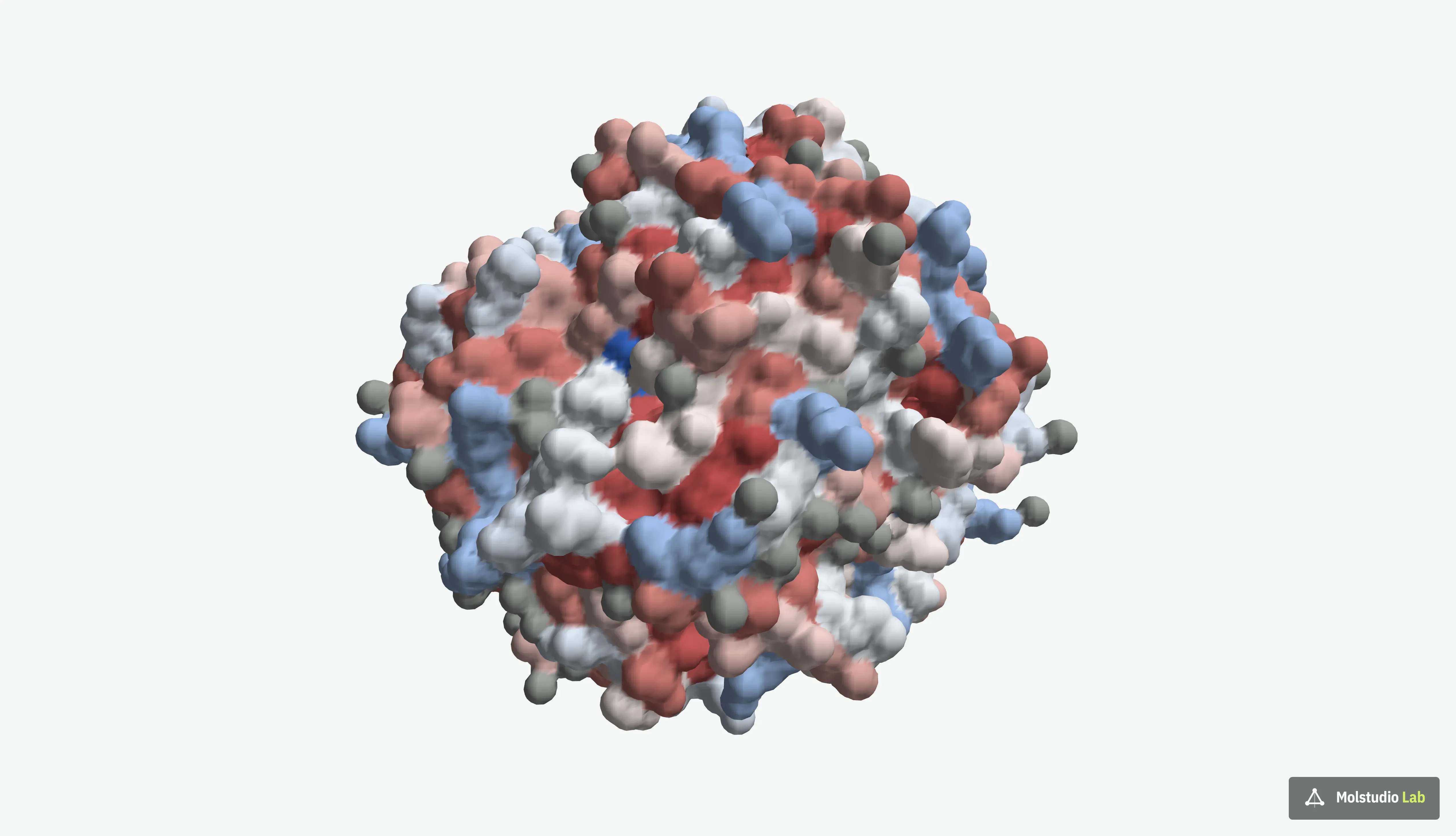
Load a structure into Molstudio Lab and ask it for pockets. It hands back volumes, and the method that produced them: the grid points a carbon probe found favourable, at the spacing you set, measured against the Bondi radius set. Both halves arrive together. Somebody who was not there can take that result and get the same number.
What it does
The Lab is the scientific half of Molstudio. Same browser tab, same rule about where your data goes: nothing leaves this browser unless you request an archive record or configure a provider. It opens PDB, mmCIF, SDF, MOL and MOL2 files, and reads CCP4 or MRC density beside them.
There are 64 tools. They cover contacts and hydrogen bonds, secondary structure, solvent-accessible surface area, pockets and cavities, chain interfaces, conservation, geometry validation and Ramachandran statistics, sequence and structure alignment, nucleic acid geometry, electrostatic fields, normal modes, energy and minimisation, short dynamics, docking, virtual screening, mutation and loop hypotheses, and density-guided fitting. Some are closed-form arithmetic over the coordinates and return in a frame. Others are searches with a step budget, and those report where they got to.
Every number shows its working
Each result carries the method that produced it, the parameters it ran with and the scope it covered. A docking score comes back with its seed and its box, so the run repeats exactly. Buried interface area comes back with the subtraction it made: each side alone, then the two together, at these coordinates. A dynamics run gives you the degree-of-freedom count behind its temperature. A common-substructure search tells you whether it finished, which is the difference between the largest shared scaffold and the largest one found so far.
That makes a result something you can argue with. Change the convention, run it again, and watch which way the number moves. A figure gets reproduced from what is written beside it rather than from somebody's memory of which boxes were ticked.
One published set, all the way through
The mechanics parameters are the UFF nonbond set of Rappe and co-workers, 1992: 102 elements plus deuterium and tritium, machine-read from RDKit's copy of the published table rather than retyped out of it. The result records the UFF atom type picked for each element and the conversion applied to get sigma and epsilon, so any term in an energy can be followed back to the row it came from.
The table carries a version and a hash of its own rows, and both travel with every energy it produces. Two runs a month apart can be compared knowing they used the same numbers, or told apart the moment they did not.
Deposited coordinates are never modified. The choices that change what a calculation sees, such as which model or which alternate location, are recorded in project history.
The method is named
A tool that says it assigns secondary structure has named no method, and the several available ones disagree about real proteins. So each tool states the one it implements and the paper it comes from, on the result rather than in a manual you have to go and find. Secondary structure is the Kabsch and Sander 1983 hydrogen-bond energies. Cartoon ribbons are built the way Carson and Bugg build them in their 1986 paper. Van der Waals radii are Bondi 1964. Hydrophobicity is whichever of Kyte and Doolittle, Eisenberg or Hopp and Woods you chose, and the result says which.
Running it
The Lab opens in one browser tab, the shared Molstudio account provides the website identity, and the manual documents every tool, what it computes and the conventions it computes it under.